
Curtains hang in the same spot for years, soaking up everything the room produces. Cooking grease drifts to them, dust settles in every fold, pets rub against the hems, and sunlight bakes the side facing the window. Then one day someone opens the curtains to let in light and a cloud of dust drops from the pleats, or the lower edge turns out to be speckled with dark spots. The first instinct is to throw them in the washing machine, which is how many a good pair ends up a size smaller.
Curtains tend to be missed in a regular clean, including one arranged through cleaning services durham nc, because they hang above eye level and look fine until they don’t. That is also why they are cleaned badly when the moment arrives: a rushed wash on the wrong cycle, a hot dryer, an iron on the wrong setting. Whether the household handles the job or leaves it to cleaning services, the method matters far more than the effort.
The good news is that most curtains need far less than people think. A little dry cleaning on the hanging fabric, a careful wash when the care label allows it, and a sensible way of drying are enough for nearly every pair.
Read the Care Label Before Anything Else
Every curtain has a label, usually sewn into a seam at the top or the side hem, and it decides everything else. A label that says machine washable, with a temperature and a cycle, is an invitation. One that says dry clean only means exactly that, especially for lined drapes, silk, velvet, anything with embroidery or beads, and fabrics with a backing or a blackout coating.
If the label is missing, treat the fabric as delicate. Cotton and polyester are the most forgiving, linen shrinks, wool and silk are fragile, and velvet crushes. Test a hidden hem with a damp white cloth to see whether the colour runs before using any liquid. If a pair has been hung for a very long time, the fabric near the window may be weaker than the rest from sun exposure, and an attempt to wash it may tear it.
Lined curtains deserve extra caution, because the lining and the face fabric can shrink at different rates, which leaves a hem that puckers or a lining that shows below the edge. Many makers recommend dry cleaning for the whole curtain for that reason, and anyone helping, family or cleaning services, should be told which curtains are dry clean only.
Dust Them Without Taking Them Down
The simplest cleaning is also the most useful. Dust accumulates faster than dirt, and removing it regularly keeps the fabric from needing a wash at all. Use a vacuum with a soft brush attachment and work from the top downward, holding the fabric lightly so it doesn’t pull into the nozzle. Go gently over pleats, where dust gathers in the folds.
A monthly pass with a brush attachment is enough to stop dust settling in, and the same pass is a reasonable extra to ask of CJS Cleaning Solutions where the curtains are accessible and the fabric is sturdy. Don’t use a vacuum on delicate or loosely woven curtains, because the suction can distort them.
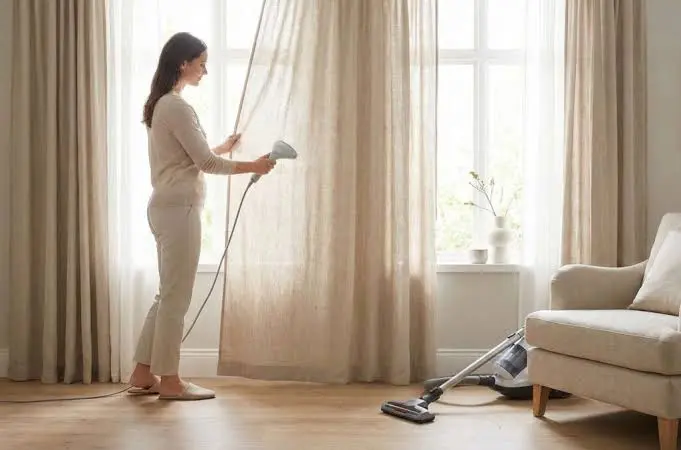
For a deeper dust removal, curtains that can tolerate it can be shaken outdoors, or tumbled in a dryer on a no-heat or air-only setting for ten to fifteen minutes, which loosens dust that the fabric holds. This works on many washable curtains and some lined ones, but check the label first, because heat shrinks and a tumbling drum can snag trims. A handheld steamer on a low setting, used a few centimetres from the fabric, relaxes creases and freshens odours on some fabrics, though heat damages others.
Washing Curtains Without Shrinking Them
If the label allows machine washing, prepare the curtains first. Remove every hook, ring, and weight, because metal pieces damage the drum and the fabric. Shake out loose dust, and pre-treat obvious stains with a small amount of mild detergent on a damp cloth, blotting rather than rubbing.
Wash them alone, or with a few light items, so the drum has room. A crowded machine creases fabric and leaves detergent in the folds. Use a delicate or gentle cycle with cool or lukewarm water, a mild detergent, and a low spin speed, since hot water and a fast spin cause most shrinkage and creasing. If the care label gives a lower temperature than your usual setting, follow the label.
For fragile or sheer fabrics such as voile and nets, a mesh laundry bag or a hand wash in a bath of lukewarm water prevents snagging. Press the water through rather than wringing, because twisting wrecks the fibres. Rinse until the water runs clear, and handle wet curtains carefully, since they are very heavy.
Drying, Ironing, and Rehanging
Drying is where most shrinking happens. Avoid a hot dryer unless the label specifically permits it, and even then use a low setting and take the curtains out while they are still slightly damp. Many curtains do better hung back at the window when damp, where gravity and their own weight pull out creases and the fabric keeps its length. Alternatively, hang them over a clothes line in the shade, or over a rail indoors. Washing on a dry, breezy morning well ahead of a clean by CJS Cleaning Solutions also stops heavy wet fabric dripping onto freshly done floors.
If ironing is needed, follow the label and use a low setting. Iron while the fabric is slightly damp, on the reverse side, and keep the iron moving, since scorching is easy. Use a pressing cloth on heat-sensitive fabrics, and never iron coated or backed curtains, such as blackout, because heat can damage the coating. Check each ring or hook before rehanging, and replace any that are bent or rusty, since rust leaves orange spots on freshly washed fabric.
Before rehanging, dust the track or rail and wipe the sill. Clean curtains going back on a dusty rail pick up dust immediately.
Sun Fading, Odours, and Mould Spots
Sunlight is the slow enemy. Ultraviolet light breaks down dyes and weakens fibres, which is why the side of the curtain nearest the glass fades and sometimes splits at the folds. A lining adds a layer of protection, and swapping curtains between windows or occasionally adjusting how they hang helps spread the exposure. Drawing them during the strongest sunshine slows the damage.
Cooking smells and cigarette smoke cling to fabric. Airing curtains outdoors on a breezy day removes much of it, and a gentle steam relaxes the fibres where the label allows. A rinse in the washing machine with a mild detergent often works for washable curtains.
Black or grey spots near the lower edge usually mean mold from condensation on the window. Wash the curtain if the label permits, or treat small areas with a mild solution after testing a hidden spot, and avoid mixing cleaning products. More important is the cause. A window that runs with condensation needs better ventilation, a dehumidifier, or a better seal, and curtains that touch wet glass will keep getting spotted until the moisture is dealt with.
Don’t Forget the Rails and Hooks
The rod, track, finials, and rings collect dust and sometimes grease. Wipe them with a damp cloth, drying afterwards, and check that fixings and brackets are tight. A wobbly bracket can bring down a heavy curtain, and a rusty ring can mark fabric. Wiping a window sill takes seconds and prevents dirty water marks on the hem.
For wide windows or high rails, use a stable step stool and never stretch from a chair.
A Simple Schedule for Curtains
Most curtains need a monthly vacuum or shake, a wash or professional clean once or twice a year, and extra attention in kitchens, near smokers, or in homes with pets. Curtains washed in spring and again in autumn line up neatly with seasonal deep cleans, including any arranged with CJS Cleaning Solutions.
Check hems for wear whenever you clean, and repair loose stitching early, because a small tear spreads.
Gentle Methods Last Longest
Curtains stay in good shape when they are dusted regularly, washed only when the care label says so, kept out of hot dryers, and protected from strong sun. A lined drape, a velvet panel, or a fabric with a coating belongs with a professional cleaner, and the rest can be handled at home with a little care. Whether the work is done by you or by cleaning services, gentle handling and slow drying keep the fabric the right size and the colour in place for years.
Also read
- The Ultimate Escape at Sea: Combining Sophistication, Privacy and Personalised Service
- What Changes When You Move Up The Residential Property Ladder
- HGS Meaning in Text: Full Form, Chat Slang & Social Media Uses (2026 Updated)