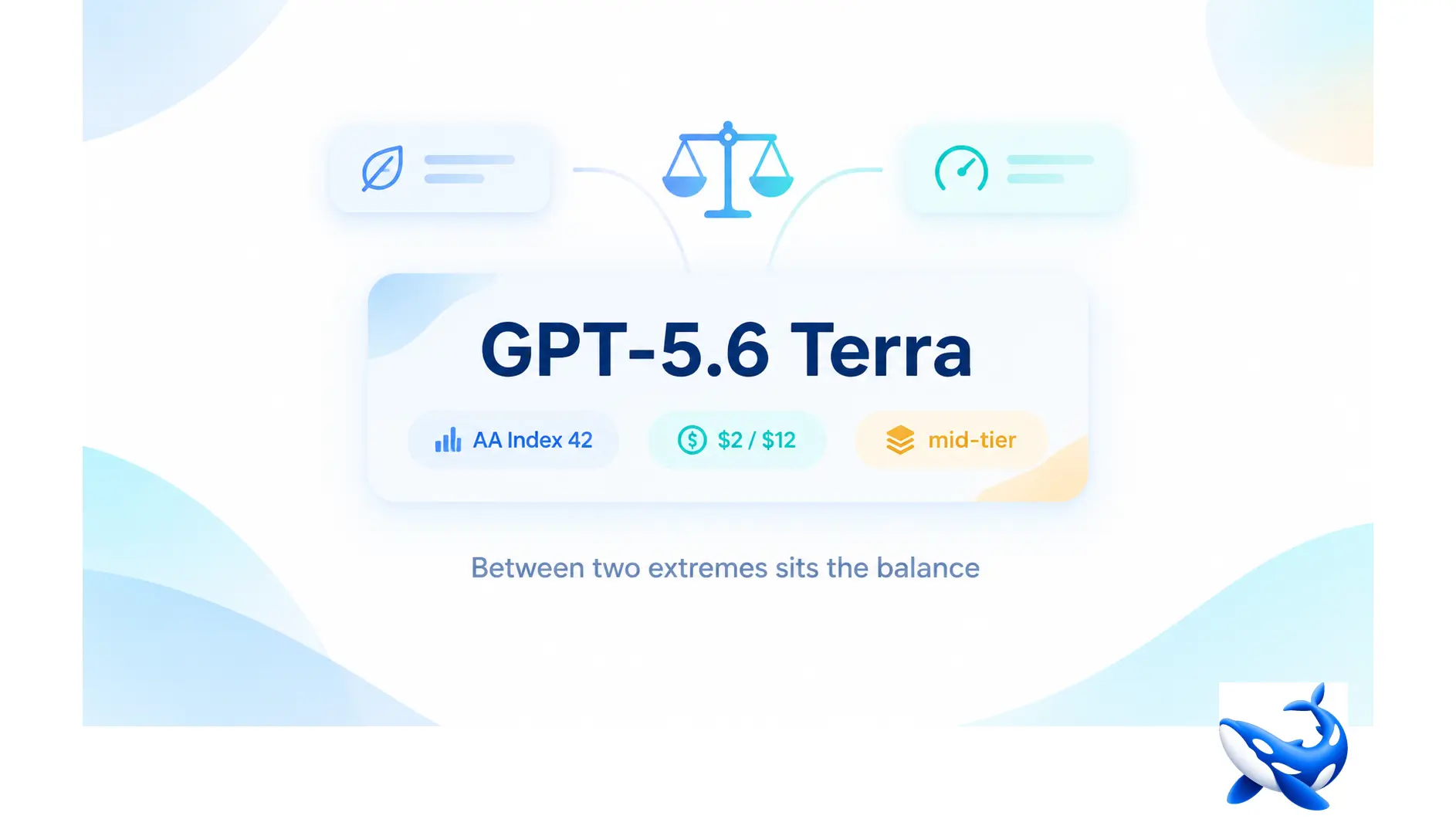
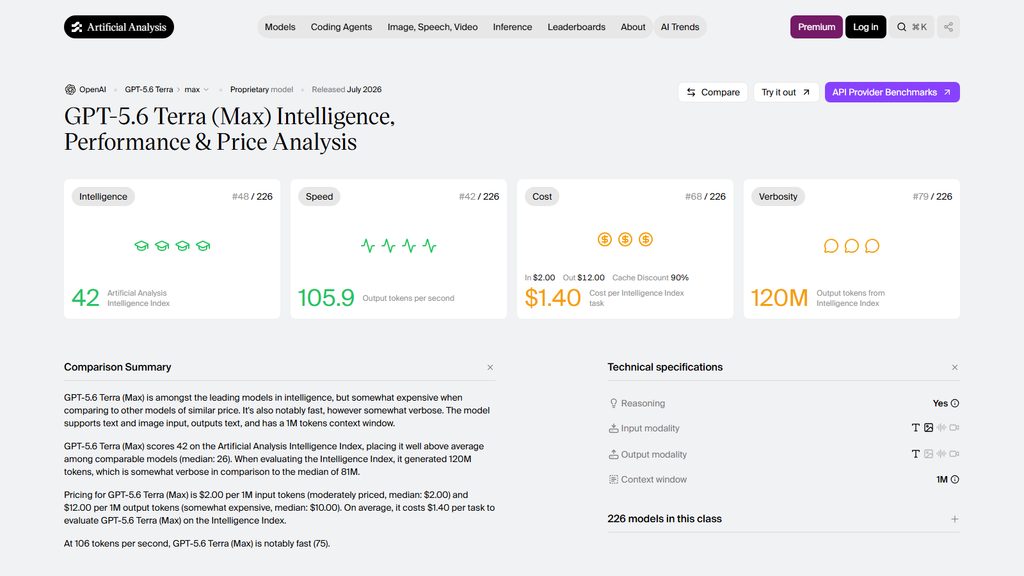
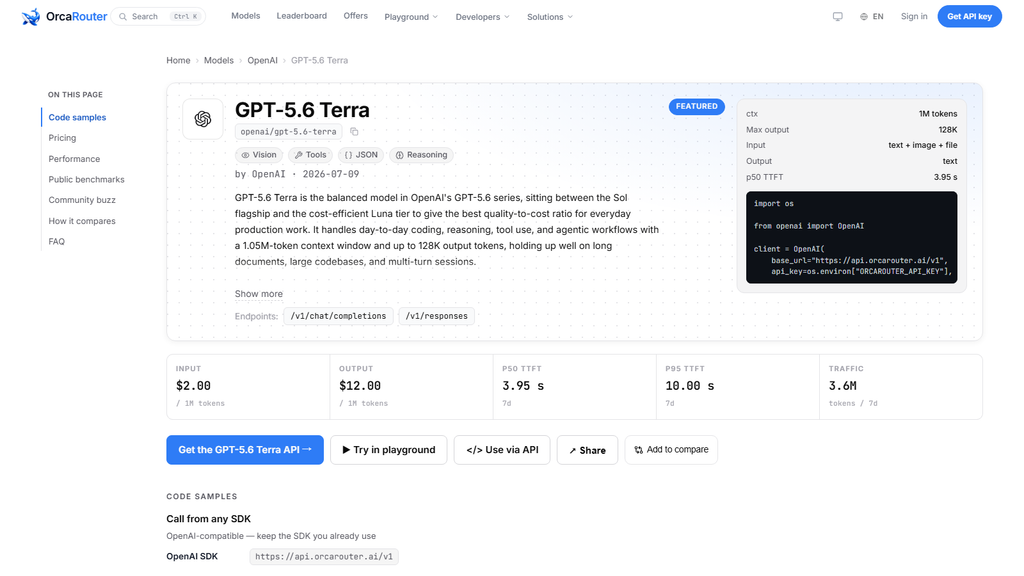
On OrcaRouter we host the GPT-5.6 Terra model — the middle rung of OpenAI’s 5.6 family, shipped on July 9, 2026, priced at $2 per million input tokens and $12 per million output, with a 1.05M-token context window. Artificial Analysis scores it 42 at the max reasoning setting with a measured output speed of 108.2 tokens per second and a per-task cost of $1.40, and in production its p50 time-to-first-token is 4.10 seconds. It is served at list price on the same key as every other OpenAI model, with the live telemetry on the linked page.
Mid-tier models get the least interesting marketing, and they deserve better, because the middle of a pricing ladder is where the majority of real workloads actually live.
What “middle” really means in this family
The 5.6 family is a three-rung ladder: Luna at $0.20 / $1.20, Terra at $2 / $12, and Sol at $4 / $20. Ten times the price separates the bottom from the top, and Terra sits exactly between them. The easy framing is that Terra is the compromise nobody gets excited about — the harder framing, and the correct one, is that a family priced this way is designed so that most teams should land on the middle.
The reason is the shape of most production traffic. A typical workload mixes long-context reads, moderate reasoning, and enough volume that price matters — which is precisely the mix the middle rung is built for. The cheap rung is for the low-difficulty bulk, the expensive rung is for the reasoning ceiling, and everything in between is Terra’s lane. That is not a positioning problem; it is the whole point of the tier.
The numbers back the shape: Terra answers at 42 (max) on the independent index — five points above the cheap rung and five below the flagship — at a per-task cost of $1.40 that sits between $0.18 and $1.99. The middle is not a compromise cobbled from leftovers; it is the rung whose whole construction is the average workload. A vendor that prices three rungs this evenly is telling you where the traffic is expected to settle, and it is not at the extremes. The rung’s own production record agrees: 5.3 million tokens a week is the smallest in the family, but the number is stable, and stability is itself a sign that the tier’s buyers are deliberate rather than accidental.
The family table
| model | context | input / output | AA index (config) | per-task cost | p50 TTFT |
| GPT-5.6 Luna | 1.05M | $0.20 / $1.20 | 37 (max) | $0.18 | 1.55 s |
| GPT-5.6 Terra | 1.05M | $2 / $12 | 42 (max) | $1.40 | 4.10 s |
| GPT-5.6 Sol | 1.05M | $4 / $20 | 47 (max) | $1.99 | 1.36 s |
Context windows and rate cards are what OpenAI lists; the index and per-task costs are Artificial Analysis’s live readings; the TTFT column is production telemetry from the linked page. Read the index column and the pricing column together and the mid-tier bargain becomes visible: Terra’s five-point gap to the flagship costs half the price, while the cheap rung’s five-point gap below costs a tenth. The middle rung is where the price-to-score curve bends the most — the biggest quality jump per dollar in the entire family.
The measured output speed of 108.2 tokens per second keeps the middle rung viable for high-volume work: it streams more slowly than the cheap rung’s 113.9, but the gap is small enough that throughput rarely decides the choice between the two. What decides it is the index — a 42 against a 37 is a real difference on reasoning-heavy workloads, and it costs ten times the price only if the volume is large. For a mid-volume team the per-task figure of $1.40 is the number to budget against, and it is the honest cost of buying the score without buying the flagship.
What the middle does not sell
There is an honest caveat the middle rung has to carry, and it shows in the same table: Terra’s 4.10-second p50 first token is the slowest in the family, roughly three times its cheap sibling and its flagship. In a family where Luna answers at 1.55 seconds and Sol at 1.36, the middle rung is the latency laggard. A team that mostly cares about fast first answers gets the same trade from the top or bottom of the ladder for better prices.
That tension is real and it is why the family exists at all: the vendor is deliberately selling a latency difference that does not track the index difference, forcing buyers to actually weigh latency against score. The honest mid-tier buyer is one whose workload tolerates four seconds of first-token time and benefits from the score-per-dollar that the middle rung uniquely delivers.
Reading the traffic in the middle
The linked page shows Terra’s own seven-day window: a p50 first token of 4.10 seconds and 5.3 million tokens of production traffic. That number is small next to its siblings — the cheap rung moves 169.7 million tokens a week — and that asymmetry is the market’s quiet verdict on the middle rung. When a mid-tier card is priced ten times above the entry card for a five-point index gain, much of the volume that would have hit the middle migrates to the bottom.
The honest reading is that Terra’s traffic is what it is because buyers are pricing the difference, not because the model underperforms. The endpoint’s telemetry shows a healthy, stable card doing exactly the job its tier is designed for. The buyer who lands on Terra is not making a mistake — they are making a deliberate choice that the score-per-dollar of the middle rung beats the latency and price extremes of the family.
That deliberate choice deserves a more specific description: Terra is the card a team picks when its workload has already been measured. A pipeline that knows its p50 tolerance — four seconds, say — can take the middle rung’s latency off the table and shop purely on score per dollar, and on that axis Terra beats both extremes. The cheap rung’s five-point gap is too large for reasoning that matters, and the flagship’s five-point gain costs half again as much for a latency win the workload never asked for. The middle rung is not the default because it is exciting; it is the default because it is the correct answer to a measured requirement.
The takeaway
GPT-5.6 Terra is the middle rung of OpenAI’s 5.6 ladder: $2 / $12, a 1.05M context window, an independent 42 (max) index score, and a measured p50 first token of 4.10 seconds — the family’s slowest but its biggest score-per-dollar step. Its 5.3 million weekly tokens trail its siblings because the pricing ladder does its job, but the trade it offers is unique in the family: a 5-point index jump over the cheap rung for a tenth of the price gap, at the cost of latency.
If your workload tolerates a four-second first token and values quality per dollar, the middle rung is the family’s best buy, and the linked page shows the telemetry to confirm it before you commit traffic.
Also Read
- 18+ Unique Similes for Life (2026) – Creative, Deep & Easy Examples
- What Changes When You Move Up The Residential Property Ladder
- Furniture Storage Dubai: Practical Self Storage Dubai Choices