
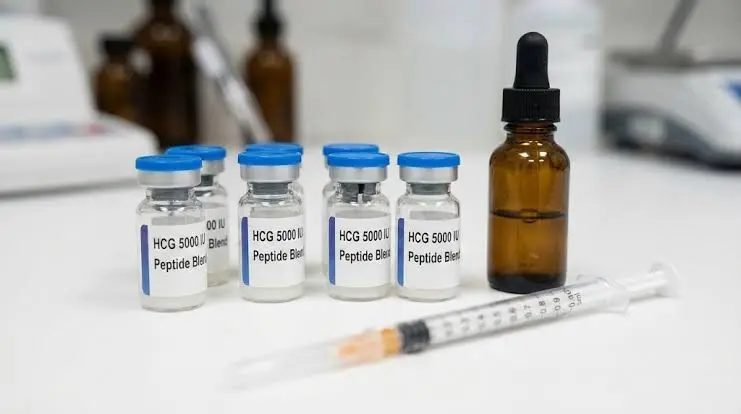
HCG and tirzepatide are two very different molecules that are sometimes placed in the same broad category of peptide-related compounds. However, their biological mechanisms, receptor targets and physiological roles are separated by a considerable distance.
HCG, or human chorionic gonadotropin, belongs to the gonadotropin family of glycoprotein hormones and is closely associated with reproductive endocrinology and pregnancy. Tirzepatide, on the other hand, is a dual-receptor peptide designed to interact with the receptors for two metabolic hormones: GLP-1 and GIP.
Comparing the two is therefore less about deciding which compound is more significant and more about understanding how different hormone signalling systems operate.
This article examines their mechanisms, molecular characteristics and receptor pathways from an educational perspective. The compounds discussed are not intended for human consumption, self-administration or medical use.
HCG and Tirzepatide Belong to Different Biological Systems
The first distinction is their physiological context.
HCG is naturally produced during pregnancy, primarily by cells associated with the developing placenta. Its main biological role involves supporting the hormonal environment of early pregnancy.
Tirzepatide is based on incretin biology. It is designed to activate both the GLP-1 receptor and the GIP receptor, two receptors involved in metabolic signalling.
This means that HCG primarily belongs to the reproductive endocrine system, while tirzepatide belongs to the broader field of metabolic and incretin signalling.
The fact that both are protein-based molecules does not make their functions comparable in a conventional sense.
What HCG Does at the Receptor Level
HCG 5000iu peptide interacts with the luteinising hormone/choriogonadotropin receptor, commonly abbreviated as LHCGR.
LHCGR is a G-protein-coupled receptor associated with reproductive tissues. It can also be activated by luteinising hormone (LH), which explains the structural and functional relationship between HCG and LH.
When HCG interacts with LHCGR, it initiates intracellular signalling pathways that influence processes such as steroid hormone production.
During early pregnancy, HCG signalling helps maintain the corpus luteum. The corpus luteum produces progesterone, which plays an important role in maintaining the hormonal environment required during the early stages of pregnancy.
HCG is therefore best understood as a reproductive signalling molecule rather than a metabolic peptide.
Tirzepatide and Dual-Receptor Signalling
Tirzepatide takes a fundamentally different approach.
Instead of targeting a reproductive hormone receptor, it is designed to activate both the GLP-1 receptor and the GIP receptor.
GLP-1 and GIP are naturally occurring incretin hormones. They are released in response to nutrient intake and participate in signalling between the digestive system, pancreas and other metabolic tissues.
Tirzepatide’s dual-receptor activity is one of its defining characteristics. Rather than reproducing the activity of one naturally occurring hormone, its molecular design allows researchers to investigate the combined effects of two related metabolic signalling pathways.
This is why tirzepatide is often described as a dual agonist.
GLP-1 and GIP: Two Different Incretin Pathways
Understanding tirzepatide requires looking at the two receptors it targets individually.
GLP-1
GLP-1 is an incretin hormone involved in glucose-dependent insulin secretion, glucagon regulation, gastrointestinal activity and appetite-related signalling.
Its receptor is found in several tissues, and activation triggers intracellular signalling pathways that can influence cellular metabolism and hormone secretion.
GIP
GIP, or glucose-dependent insulinotropic polypeptide, is another incretin hormone. It was historically studied primarily for its effects on insulin secretion, but research has demonstrated that its biological role is more complex than that alone.
GIP receptor signalling interacts with metabolic processes in several tissues, making it an important subject in modern endocrine research.
Tirzepatide brings these two pathways together within one molecule.
HCG vs Tirzepatide: Different Receptors, Different Questions
At the simplest level, the difference can be represented as:
HCG → LHCGR → reproductive signalling
Tirzepatide → GLP-1 receptor + GIP receptor → metabolic signalling
The distinction is important because receptor selection determines much of the biological context in which a molecule operates.
HCG and LH are closely connected because they interact with the same major receptor system. Tirzepatide, meanwhile, is designed around two incretin receptors that are involved in metabolic communication.
This means researchers studying the two compounds are generally asking very different biological questions.
With HCG, the focus may involve reproductive endocrinology, gonadotropin signalling and steroidogenesis.
With tirzepatide peptides, the focus is more likely to involve incretin signalling, glucose-related pathways, pancreatic responses and interactions between metabolic systems.
Their Molecular Structures Are Also Distinct
HCG and tirzepatide differ significantly at the molecular level.
HCG is a glycoprotein hormone consisting of alpha and beta subunits. The molecule also contains carbohydrate groups attached to the protein structure. These modifications contribute to its stability and biological behaviour.
Tirzepatide is a modified peptide designed around incretin receptor activity. Its structure incorporates features that allow it to interact with both GLP-1 and GIP receptors while also giving it a longer duration of biological activity than the naturally occurring hormones on which the concept is based.
This difference illustrates an important point about peptide biology: two molecules can both be described broadly as peptide or protein-based compounds while having very different structures and pharmacological characteristics.
Why HCG and Tirzepatide Should Not Be Compared as Substitutes
Because the two compounds operate through unrelated endocrine systems, comparing them as if they were interchangeable does not make much biological sense.
HCG does not represent an alternative form of GLP-1 or GIP signalling. Likewise, tirzepatide does not reproduce the reproductive signalling associated with HCG.
Their mechanisms are fundamentally different.
A useful comparison is therefore not about which one is “stronger”. Instead, it is about which receptors they interact with, where those receptors are expressed and what signalling pathways follow receptor activation.
This approach provides a much clearer understanding of why their biological profiles are so different.
Intracellular Signalling
Both HCG and tirzepatide ultimately rely on receptor-mediated signalling inside cells.
Their primary receptors belong to the G-protein-coupled receptor family. When an appropriate ligand binds to one of these receptors, the receptor changes its conformation and activates intracellular signalling proteins.
One important pathway involves cyclic AMP (cAMP), which can act as a second messenger and influence downstream cellular processes.
However, the receptor being activated determines the biological context. Activating LHCGR produces a signalling response associated with gonadal and reproductive functions, while activating GLP-1 and GIP receptors influences metabolic and endocrine processes.
The shared receptor family therefore does not mean the biological outcomes are equivalent.
A Useful Side-by-Side Comparison
| Characteristic | HCG | Tirzepatide |
| General classification | Glycoprotein hormone | Modified peptide |
| Main biological system | Reproductive endocrinology | Metabolic/incretin signalling |
| Primary targets | LHCGR | GLP-1 receptor + GIP receptor |
| Natural relationship | Closely related to LH | Based on incretin hormone biology |
| Receptor strategy | Single primary receptor system | Dual-receptor agonism |
| Major research context | Pregnancy and reproductive signalling | Metabolic and endocrine signalling |
| Molecular structure | Alpha and beta subunits with carbohydrate groups | Modified peptide structure |
This comparison highlights why the two compounds belong to very different areas of biological research.
What the Comparison Tells Us About Modern Peptide Research
The contrast between HCG and tirzepatide also illustrates how peptide research has evolved.
HCG is a naturally occurring hormone whose biological role has been understood through reproductive endocrinology. Its receptor relationship with LH provides an example of how closely related hormones can interact with the same receptor system.
Tirzepatide represents a more deliberately engineered approach. Rather than reproducing the activity of only one hormone, its molecular design incorporates activity at two incretin receptors.
This reflects a broader interest in multi-receptor signalling and the possibility of coordinating several biological pathways with a single molecule.
It also demonstrates why receptor pharmacology is often more informative than simply categorising compounds as “peptides”.
Final Thoughts
HCG and tirzepatide represent two very different branches of endocrine biology.
HCG is a glycoprotein gonadotropin associated with reproductive signalling, pregnancy and the LHCGR receptor system. Tirzepatide is a dual-receptor peptide associated with GLP-1 and GIP signalling and the broader field of metabolic endocrinology.
The most useful way to compare them is therefore through their receptor targets and biological pathways, rather than through general labels such as “peptide” or assumptions about relative strength.
HCG demonstrates how hormone signalling can regulate reproductive processes, while tirzepatide illustrates the modern development of molecules capable of interacting with multiple metabolic pathways.
Together, they provide a useful example of the diversity of peptide and protein-based signalling in biology and the increasingly sophisticated approaches used to study these systems.
This article is provided for educational and scientific information only. HCG and tirzepatide discussed here are not intended for human consumption, self-administration or use as medical treatment.
Also read
- How Accelerated Online Degree Programs Work in 2026
- Top 5 Outsourcing Companies in Latin America for Different Budgets
- Remote Chronic Care Management: A Guide for Healthcare Providers