
Last updated: November 2026. Please ensure you are using official sources.
Most business owners in the UAE will manage their books, VAT and filings carefully, often by using Tax Compliance Services. But when an inspector requests to review your AML file many businesses find that having a policy in a file does not necessarily mean you have a working framework in place. This guide outlines what the regulators will be looking for and how to address the issues in the first instance.
The rules changed recently
Federal Decree-Law No 10 of 2025 was issued on 14th October 2025 with implementing regulations issued in Cabinet Resolution No 134 of 2025 dated 14th December 2025. This supersedes the 2018 legislation and the 2019 regulations.Any reference to the previous legislation in your AML Policy will be picked up by an inspector very easily.
Does your business have AML obligations?
Not all companies in the UAE will be subject to AML requirements. AML requirements apply according to the activity you are licensed to carry out, your regulatory status and your supervisor.
Typically covered groups include:
- Financial institutions (banks, exchange houses)
- Designated non-financial businesses/professions (DNFBPs) real estate agents, bullion dealers, auditors, accountants, legal professionals, corporate service providers.
- Licensed virtual asset service providers.which handle crypto-related activity under a licence.
There are different regulators. Many DNFBPs will be subject to regulation by the Ministry of Economy. While financial institutions will be regulated by the Central Bank. DIFC entities will be regulated by the DFSA while entities in ADGM will be regulated by the FSRA.
Just because you are operating in Dubai does not mean you will be regulated by the DFSA.Firstly confirm where you stand and then create your policy.
What a regulator-ready policy contains?
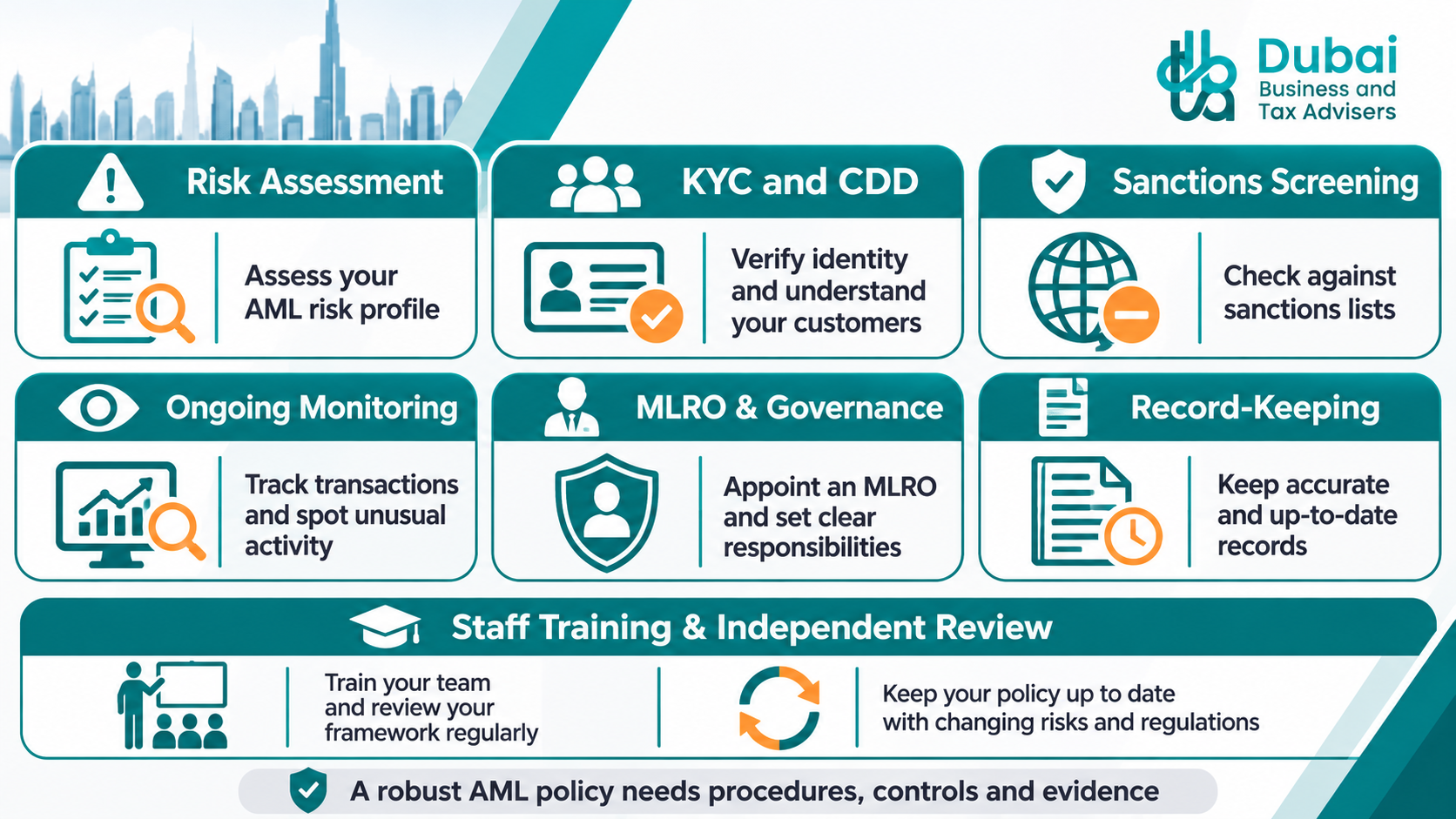
A good policy reads like your business, not a template. It should cover these fifteen areas.
- Scope and Legal Basis: What are your activities, how many branches do you have? How many employees? Reference to current legislation.
- Senior Management: This will be approved, funded and handled by the directors.
- MLRO: This will receive any internal concerns and will assess whether they should be reported externally.This role must be given genuine authority and have a direct line to senior management. How this role is appointed will depend on the category. Please check the appropriate rules.
- Risk Assessment: Assess your overall AML risk. This should cover your customers, countries, services, amounts and onboarding methods.Write down what you find. A vague “medium risk” label proves nothing.
- Customer acceptance. Decide who you will take on, who needs senior approval and who you will refuse. Record each decision.
- KYC and CDD.Know your customer (KYC) and Customer Due Diligence (CDD) is more than just photocopying the Passport. It involves verification of identification, understanding the reason for the relationship and keeping up-to-date.
- Beneficial ownership. Picture a trading firm owned by a holding company, owned by an offshore entity, owned by a trust. The trade licence shows only the first layer. Effective UBO verification means finding the individuals who ultimately own or control it.
- Enhanced due diligence & PEPs. Cases with higher risk will require enhanced due diligence including source of funds. PEPs do not constitute an automatic decline but must be looked at more thoroughly.
- Sanctions screening. Sanctions screening covers customers and owners. Review matches and escalate doubtful ones. Repeat it regularly, not just at onboarding.
- Ongoing monitoring. Say a low-risk customer starts moving money in ways that don’t fit their profile. The old rating no longer holds. Re-rate them and ask questions.
- Suspicious activity reporting. An employee raises a concern internally. The MLRO reviews it and decides whether to file a suspicious transaction report through goAML, the UAE’s reporting platform. Never tip off the customer. Registering on goAML proves nothing by itself. Your process does.
- Record-keeping. Keep files organised, secure and retrievable. Check the retention periods that apply to you.
- Training. Match training to each role. A front-desk employee who can’t recognise red flags is a gap.
- Independent review. Test whether people follow procedures. Smaller firms don’t need three departments, just someone objective.
- Version control. Update the policy when law, services or customers change. Keep a dated approval history.
Policy, procedure, control and evidence
People mix these up constantly. Your AML policy and procedures should show all four.
| Element | Example |
| Policy | We carry out risk-based due diligence on every customer. |
| Procedure | Staff collect documents, verify ownership and assign a risk rating. |
| Control | Compliance checks the file before approval. |
| Evidence | The completed file, rating and sign-off record. |
A policy without the other three is a promise nobody can prove.
Getting ready for an inspection
An AML inspection tests whether the framework works in practice. Gather these before inspectors ask:
- Approved policy and procedures
- Current risk assessment
- Customer files with ownership checks
- EDD and PEP records
- Screening results and alert decisions
- goAML registration and reporting records
- MLRO appointment record
- Training records
- Audit results and corrective actions log
Do not invent any documents but note what is missing, identify why it has not been completed, what the risk is, document owner and escalate any issues that you cannot resolve. Are there any similar issues with other files?
Evidence of truthfulness is better than pretty lies!
Where good-looking policies fail
Often it comes down to generic templates, out of date information on beneficial owners and lack of power to the MLRO, single point of sanctioning and outstanding findings.
Small Business: realistic steps
Make sure you have someone accountable. With proper processes and procedures, a schedule of compliance, staff trained and appropriate records.
Getting help externally can help to create policies, identify risks, find gaps and offer training.
However, you remain responsible for what is delivered by your directors. Clearly state how much work the consultant will be undertaking. Ensure that you are monitoring the work that is being delivered by the consultant and have a strategy in place to change consultants if required.
How tax and AML support fit together
Tax and AML are separate duties. A VAT return does not satisfy an AML inspector, and an AML policy does not settle your tax position.
They do reinforce each other, though. Clean financial records and clear ownership documents make both jobs easier. Reliable tax compliance services keep your reporting accurate, while specialist AML support covers policy, risk assessment and inspection readiness. Choose advisers who explain which duty each service covers.
Fixing an existing policy: five steps
A short AML compliance review follows five steps.
- Confirm your regulatory position. Identify your activity and supervisor.
- Compare the manual with current law.
- Test your risk assessment against your real customers and transactions.
- Review live customer files for missing approvals and unresolved alerts.
- Log and fix every gap. Record the cause, owner, deadline and proof of completion. Retest before closing it.
Frequently asked questions
Do we need an AML Policy?
Not necessarily, this will depend on what activity you are licensed to carry out and what regulations you fall under. Make sure you know who your supervisor is.
Do we need an MLRO?
This will depend on the type of business you have and what regulations you fall under. Speak to your supervisor or a qualified adviser.
Is registering with goAML sufficient evidence of compliance?
No. You will need to have escalation processes, clear evaluation processes and evidence of how you deal with concerns.
Can I use an outside consultant to help with AML?
Yes, you can use a consultant for producing policies, carrying out risk assessments, providing training and reviewing gaps. However your Directors will still have responsibility over this.
How often do I need to review my AML Policy?
You will need to follow the rules of your regulator, based on your risk profile. It should be reviewed when there is a significant change in legislation, service, customers or ownership.
Conclusion
Create a policy that can be used by a regulator. Identify risks, responsibilities, ensure customer checks are carried out and keep track of any issues.
We can help you ensure you have the right set up in place for your tax and compliance. From checking your documentation to identifying any gaps in your processes before they become an issue for a regulator. Contact us at Dubai Business & Tax Advisors (DBTA) to see how we can help you and what areas you need to work on.
Read more: https://similesbook.com/can-you-still-surf-and-play-sports-while-wearing-invisalign/
https://similesbook.com/how-to-remove-mistakes-in-video-without-a-visible-cut/
https://similesbook.com/mortgage-fraud-prevention-tips-for-homebuyers/





1 thought on “AML/CFT Obligations for UAE Businesses: What a Regulator-Ready Policy Actually Contains”