

People searching for ways to win JetX are usually looking for a multiplier pattern, an ideal cash-out point, or a system that can reduce the chance of losing. The difficulty is that JetX is an RNG-based crash game. The player can control the bet amount and when to cash out, but not the point at which the flight ends. Understanding jetx therefore starts with separating player decisions from random outcomes. Choosing 1.50x instead of 5.00x changes the conditions required for a successful cash out, but it does not change the randomly generated crash point. A player can win individual rounds by exiting before the crash. That is different from having a system that guarantees profit over repeated play. JetX includes a built-in house advantage, and no cash-out method can remove the randomness behind each flight.
Can You Really Win at JetX?
Yes, individual JetX rounds can end with a successful cash out. If the player exits while the multiplier is still active, the wager is settled using the multiplier reached at that moment. However, winning one or several rounds is not the same as consistently beating the game. The crash point is generated by the game system, and there is no ordinary way for the player to know that value before the round ends. This means every strategy operates around an unknown future multiplier.
Winning a Round vs Beating the Game
Suppose a player bets 10 units and exits at 2.00x. If the multiplier reaches 2.00x before crashing, the total return is 20 units. That is a successful round. But repeating the same action does not guarantee that every future flight will also reach 2.00x. Some rounds may end earlier. Long-term results depend on the probabilities and payout structure built into the game, not only on whether a particular round was successful.
What the Player Can and Cannot Control
The player can choose the stake, decide whether to place one or two bets, select manual or automatic cash out, and set a target multiplier. The player cannot determine how far the jet will travel. This distinction is central to understanding any JetX strategy. Bet settings affect exposure and potential returns, while the RNG determines the round result.
How JetX Determines a Winning Bet

A JetX wager becomes successful when it is cashed out before the flight ends.
The basic calculation is:
Return = Bet × Cash-out multiplier
If a 10-unit wager is cashed out at 1.80x:
10 × 1.80 = 18 units
The total return is 18 units, including the original stake. If the jet crashes before 1.80x is reached, the active bet loses.
What Happens When the Jet Crashes First?
Once the flight ends, any wager that has not already been successfully cashed out is lost. This is true regardless of the intended target. For example, if the selected target is 2.00x but the jet crashes at 1.72x, the target is never reached. The same principle applies even to relatively low targets.
Why 1.00x Matters
JetX can end at a very low multiplier, including around 1.00x. This means there is no positive cash-out target that should be treated as completely safe. A low target may be reached more often than a high target, but that does not make it guaranteed.
Does a Lower Cash-Out Target Increase the Chance of Winning?
A lower multiplier generally requires the flight to continue for less time, so it is normally reached more frequently than a much higher multiplier. This is the main trade-off in crash games. Lower targets can produce more frequent successful exits but smaller returns. Higher targets offer larger potential payouts but require the flight to continue longer.
Lower Multiplier, Smaller Return
Consider a 10-unit wager at 1.50x.
If successful:
10 × 1.50 = 15 units
The net gain is 5 units. The target is relatively close to the start of the round, but the jet can still crash before reaching it.
Higher Multiplier, Larger Return but Greater Risk
Now consider the same 10-unit wager with a 5.00x target.
If successful:
10 × 5.00 = 50 units
The return is much larger, but the round must continue significantly longer. A larger potential payout is therefore tied to a less frequently reached target.
Why There Is No Best Cash-Out Multiplier
There is no universal multiplier that removes the house edge or guarantees better long-term results. Different targets change the distribution of wins and losses. A low target may create many small successful exits interrupted by early crashes. A higher target may create fewer successful rounds but larger returns when reached. Neither changes the underlying RNG.
JetX RTP and the Long-Term Mathematics

RTP, or Return to Player, is a theoretical measure of how much a game returns over a very large number of rounds. JetX can be offered with different mathematical configurations, so the published RTP may appear as a range rather than one universal percentage. RTP should not be confused with the result of a single session.
What RTP Means in Practice
If a configuration has a theoretical RTP of 98%, this does not mean that a player wagering 100 units will receive exactly 98 back. One session may return considerably more. Another may return considerably less. The percentage becomes meaningful only over very large samples.
RTP and House Edge
RTP and house edge are closely related.
The simplified formula is:
House edge = 100% − RTP
For example, a 98.9% RTP corresponds to a theoretical house edge of approximately 1.1%. A 96.2% RTP corresponds to approximately 3.8%. These figures describe long-term mathematical expectations rather than guaranteed losses in a specific session.
Why RTP Does Not Tell You the Next Multiplier
RTP is not a prediction tool. It does not indicate whether the next JetX flight will end at 1.05x, 2.50x, or a much higher value. It describes the game across many rounds, while the next multiplier remains random.
Does Skill Affect JetX Results?
JetX includes an interactive cash-out decision, but that does not mean the player can influence the random crash point. The skill-like part of the game is deciding when to exit according to a chosen plan. The flight length itself remains outside the player’s control.
Timing vs Random Outcome
Manual timing determines when the player attempts to settle a wager. It does not determine the multiplier at which the game ends. For example, choosing to wait until 3.00x is a decision. Whether the jet actually reaches 3.00x is a random outcome.
Why Fast Clicking Is Not a Strategy
Clicking the cash-out button faster cannot extend the flight. Reaction time may matter operationally because a manual exit has to be submitted while the round is still active. But fast clicking does not change the RNG or improve the probability of a higher multiplier.
Manual Cash Out vs Auto Cash Out
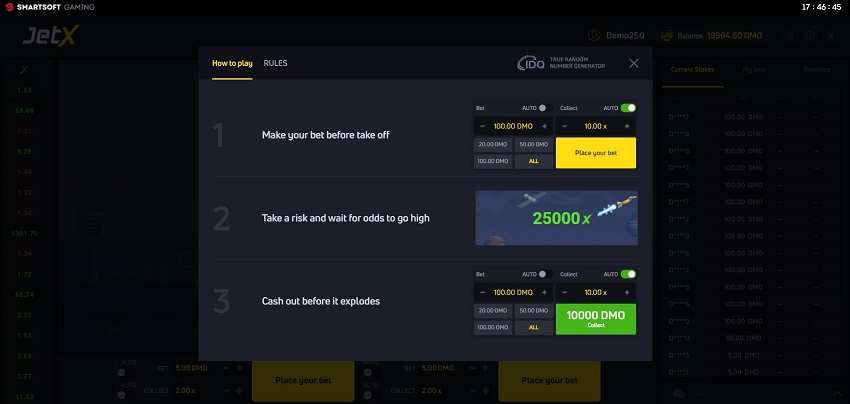
JetX normally gives players a choice between manual and automatic cash out. The two methods differ in execution rather than in the underlying probability.
Manual Cash Out
With manual cash out, the player watches the multiplier and chooses when to exit. This gives direct control over the moment the request is made. The disadvantage is that the player must react during the live round.
Auto Cash Out
Auto Cash Out allows a target multiplier to be selected before the flight. If the game reaches that multiplier, the wager is settled automatically. If the flight ends first, the target is never reached.
Does Auto Cash Out Improve the Odds?
No. Auto Cash Out does not change the crash point. Its main purpose is to execute a predetermined decision automatically. This can make the player’s behavior more consistent, but consistency is not the same as a mathematical advantage.
Can JetX History Predict the Next Round?
JetX interfaces often show recent multipliers and round statistics. These can be useful for reviewing past results, but they do not reveal the next outcome. Historical data is descriptive, not predictive.
Why Previous Multipliers Look Like Patterns
Random sequences often contain streaks. Several rounds may end below 2.00x. Several high multipliers may appear close together. The results may also seem to alternate between high and low values. People naturally look for patterns in these sequences. The presence of a visual pattern does not mean the game is following a predictable cycle.
The Gambler’s Fallacy in JetX
A common mistake is thinking that after five low multipliers, a high one must come next. This is called the gambler’s fallacy. Past results do not force the RNG to produce the opposite result in the next round.
Can JetX Be Predicted?

There is no reliable method for predicting the next crash point from publicly visible game history. Ordinary players do not receive advance access to the RNG result. Recent multipliers, animation behavior, stake sizes, and the number of players in the round do not provide a dependable prediction method.
JetX Predictor Apps and Signals
Some apps, websites, bots, or messaging channels claim to provide future JetX multipliers. These claims should be treated cautiously. A tool that simply analyzes historical multipliers cannot know the next independent RNG result merely by identifying patterns in previous ones. A history-based forecast may look convincing when it occasionally matches a future round, but occasional matches do not demonstrate predictive ability.
Why the Jet Animation Is Not a Signal
The aircraft animation represents the progress of the current round. Its speed, angle, movement, or visual effects should not be interpreted as advance information about where the crash will occur. The animation displays the game state rather than revealing hidden future values.
Does the Two-Bet Feature Improve Your Chances?
JetX allows two independent wagers during the same flight. This feature can be used to select different stakes or different exit targets. It does not change the flight itself.
Using Different Cash-Out Targets
For example, Bet A might be set to cash out at 1.50x while Bet B remains active until 4.00x. If the flight reaches 1.50x, the first position can settle. The second continues to depend on the same flight reaching 4.00x. This changes how the player’s total exposure is distributed.
Two Bets Still Depend on the Same Flight
Both wagers experience the same crash point. If the jet ends at 1.20x, both a 1.50x target and a 4.00x target fail. Placing two bets does not create two independent JetX flights.
Why Two Bets Can Increase Total Risk
If a player normally places 10 units on one bet but instead places 10 units on each of two panels, the total amount exposed becomes 20 units. The feature therefore needs to be evaluated in terms of total stake, not just the number of positions.
Can Bet Size Affect the JetX Multiplier?
Increasing the stake does not make the jet more likely to travel farther. A larger wager changes the amount of money involved, not the randomly generated crash point.
Larger Bets Change Money at Risk, Not Probability
Suppose one player wagers 5 units and another wagers 100 units on the same round. Both experience the same flight. If the multiplier ends at 1.60x, the crash point is 1.60x regardless of the size of either wager. The only difference is the financial result.
Why Doubling After a Loss Does Not Guarantee a Win

Progression systems such as Martingale are based on increasing the next stake after a loss. The theory is that a later successful wager can recover earlier losses. The problem is that the next round remains random.
The Main Problem With Martingale-Style Systems
Consider a sequence such as:
10 → 20 → 40 → 80 → 160
After only a few losses, the required wager becomes much larger. Total exposure also accumulates quickly. A longer losing sequence can therefore create substantial risk even if the initial stake was small.
A Larger Bet Does Not Change the Next Crash Point
Doubling a wager does not make the next flight more likely to reach the target. The system changes bet size. It does not change probability. This is why progression systems cannot remove the underlying house edge.
Is a Fixed Cash-Out Strategy Better Than Changing Targets?
Using the same cash-out target every round can make results easier to understand and track. It may also reduce emotional decisions based on recent outcomes. However, a fixed target does not create a guaranteed winning system.
Consistency vs Prediction
There is an important difference between following a consistent rule and predicting the game. A player who always exits at 1.80x is using a consistent process. That process does not mean the player knows whether the next round will reach 1.80x. Likewise, changing the target after several low multipliers does not provide predictive information.
Understanding Risk at Different Multipliers
Multiplier selection changes the relationship between potential return and how far the flight must continue.
| Cash-Out Approach | Potential Return | General Pattern |
| Lower target | Smaller | Reached more often |
| Medium target | Moderate | Intermediate |
| Higher target | Larger | Reached less often |
This does not identify a mathematically superior target. It simply illustrates the trade-off built into crash-game mechanics.
Why High Multipliers Are Tempting
Large multiplier values create the possibility of large returns from relatively small stakes. For example, 10 units at 20x would return 200 units if the target is reached. The important qualification is that the flight has to survive all the way to 20x. The displayed potential payout alone does not describe the probability of reaching it.
Maximum Multiplier Is Not a Typical Result
Game interfaces or rules may show very large maximum values. These describe technical limits or possible outcomes. They should not be interpreted as normal or expected results.
Can Demo Mode Help You Win JetX?
Demo mode can be useful for understanding how JetX works. It allows users to practice placing bets, using manual cash out, configuring Auto Cash Out, and managing two betting panels without using a real-money balance. It cannot reveal a hidden winning pattern.
What Demo Mode Can Teach
Demo play can help explain how quickly the multiplier rises and how the betting period works. It can also be useful for understanding the difference between manual and automatic exits. This makes demo mode practical for learning the interface.
What Demo Mode Cannot Teach
A sequence of demo results does not predict future rounds. If several high multipliers appear during a demo session, that does not imply similar results will follow later. The same applies to losing streaks.
What Actually Helps When Playing JetX?
The most useful approach is understanding how the game works rather than trying to identify a secret prediction system. Knowing that low multipliers are not guaranteed, recognizing that two bets increase total exposure, and understanding the difference between RTP and short-term returns all help prevent common misunderstandings. Predetermined cash-out settings can also make decisions more consistent. The benefit is behavioral rather than predictive.
Managing Risk Is Not the Same as Increasing Odds
Reducing stake size can reduce the amount lost when a round fails. Setting a spending limit can reduce total exposure. Using a fixed cash-out target can reduce impulsive changes. None of these actions modifies the RNG. Risk management controls financial exposure. It does not increase the underlying probability of a favorable game result.
Common Myths About How to Win JetХ

One common claim is that a high multiplier must follow several low rounds. Random outcomes do not operate according to such a simple compensation rule. Another myth is that increasing the stake causes the jet to stay in the air longer. Bet size does not determine the crash point. Predictor apps are also frequently presented as tools for finding future multipliers. Historical patterns alone cannot reveal an independent RNG outcome. Two bets do not guarantee that one will win because both depend on the same flight. Even a low cash-out target is not guaranteed because the game can end very early.
JetX and Responsible Bankroll Management
JetX rounds can occur quickly, which means a large number of wagers can be placed in a short period. This makes total spending more important than focusing only on the size of one bet.
Set a Total Limit, Not Just a Bet Size
A 5-unit wager may seem small in isolation. But 100 wagers at that amount represent 500 units of total staking. Tracking total exposure gives a more accurate picture than looking only at the current bet.
Avoid Chasing Previous Losses
A previous loss does not improve the probability of the next round. Increasing the next stake because of earlier losses therefore adds financial exposure without changing the RNG. Stopping limits and spending limits are more useful for controlling risk than trying to recover losses immediately.
FAQ About How to Win JetX
- Is There a Guaranteed Way to Win JetX?
No. A successful round requires cashing out before a randomly generated crash point, and that point cannot be guaranteed in advance.
- What Is the Safest JetX Multiplier?
There is no completely safe positive multiplier. Lower targets may be reached more frequently than higher ones, but the game can still end very early.
- Can You Predict the JetX Multiplier?
Past multipliers do not provide a reliable way to determine the next RNG-generated result.
- Does JetX Have a Pattern?
Historical results may form visual streaks or patterns, but these do not establish a reliable predictive sequence.
- Does Auto Cash Out Increase Your Chances?
No. Auto Cash Out automatically executes a selected exit point. It does not change where the jet crashes.
- Can Two Bets Improve the Odds?
Two betting panels allow different positions in the same round, but both depend on the same flight and crash point.
- Does Bet Size Affect the Crash Point?
No. A larger wager changes the amount at risk and the potential monetary return, not the randomly generated flight length.
- What Is the JetX RTP?
JetX can be offered with different mathematical configurations, so published RTP values may vary. RTP represents a theoretical long-term return rather than the result of a particular round.
- Can JetX Predictor Apps Work?
Claims that ordinary predictor tools can identify future crash points from public historical data should be treated skeptically. Past outcomes do not reveal the next independent RNG result.
- Does JetX History Help Predict the Next Round?
History shows previous multipliers. It is useful for reviewing past rounds but does not reliably forecast the next one.
- Is Martingale Effective in JetX?
Martingale changes the stake after losses but does not alter the crash probability. A losing sequence can also cause bet sizes to grow rapidly.
- Can Demo Mode Help You Find a Winning Pattern?
Demo mode is useful for learning the controls and mechanics. Its previous results cannot reveal future multiplier outcomes.
Conclusion
Winning an individual JetX round means successfully cashing out before the randomly generated crash point. The player can choose the stake, select a cash-out target, use manual or automatic exit, and place one or two bets, but none of these controls determine how far the next flight will go. Lower cash-out targets generally trade smaller potential returns for targets that are reached more often, while higher multipliers offer larger potential payouts but require the flight to continue longer. Neither approach removes the game’s mathematical house advantage. Understanding how to win JetX therefore requires an important distinction: players can control risk, stake size, and exit decisions, but they cannot reliably predict or control the next RNG-generated multiplier. A system that manages exposure may change the way results are experienced, but it is not the same as a guaranteed winning strategy.
Also Read
- 18+ Unique Similes for Life (2026) – Creative, Deep & Easy Examples
- What Changes When You Move Up The Residential Property Ladder
- Furniture Storage Dubai: Practical Self Storage Dubai Choices